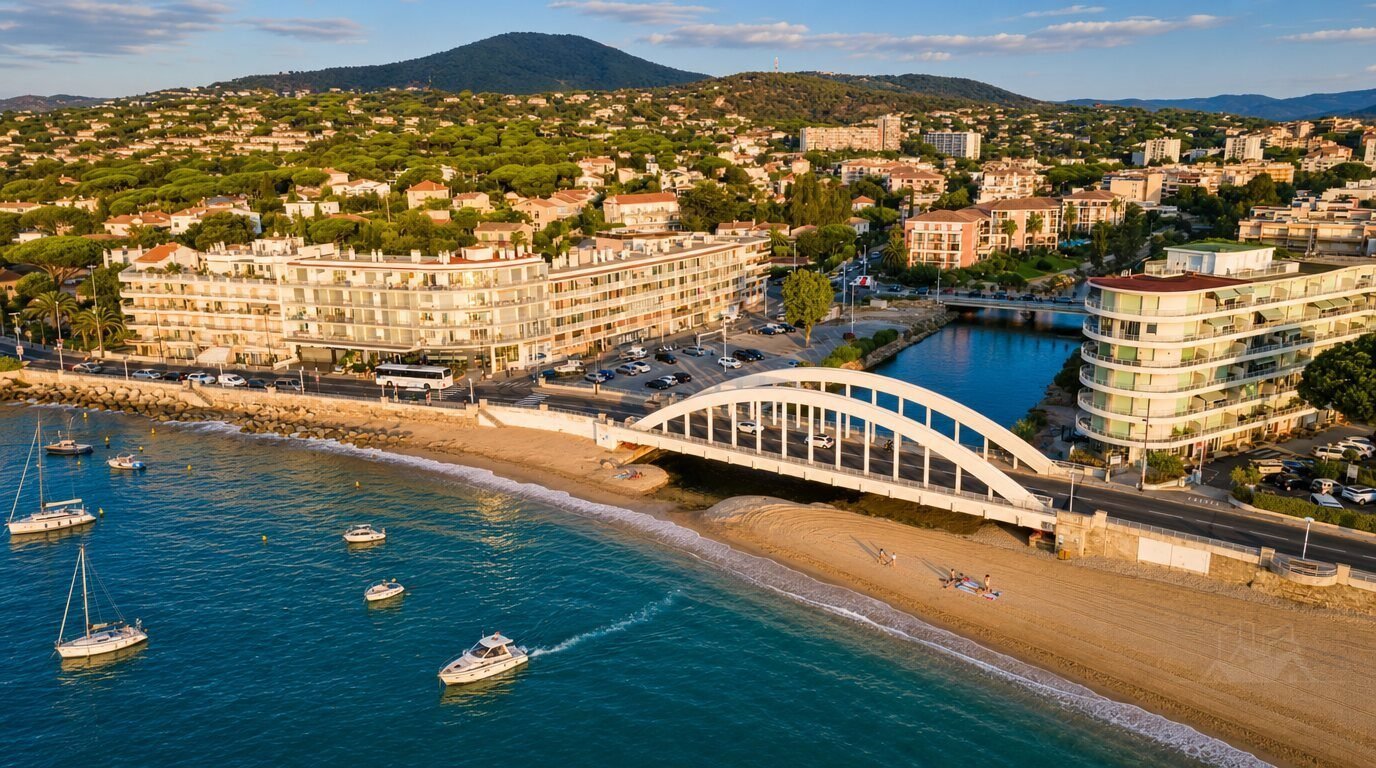
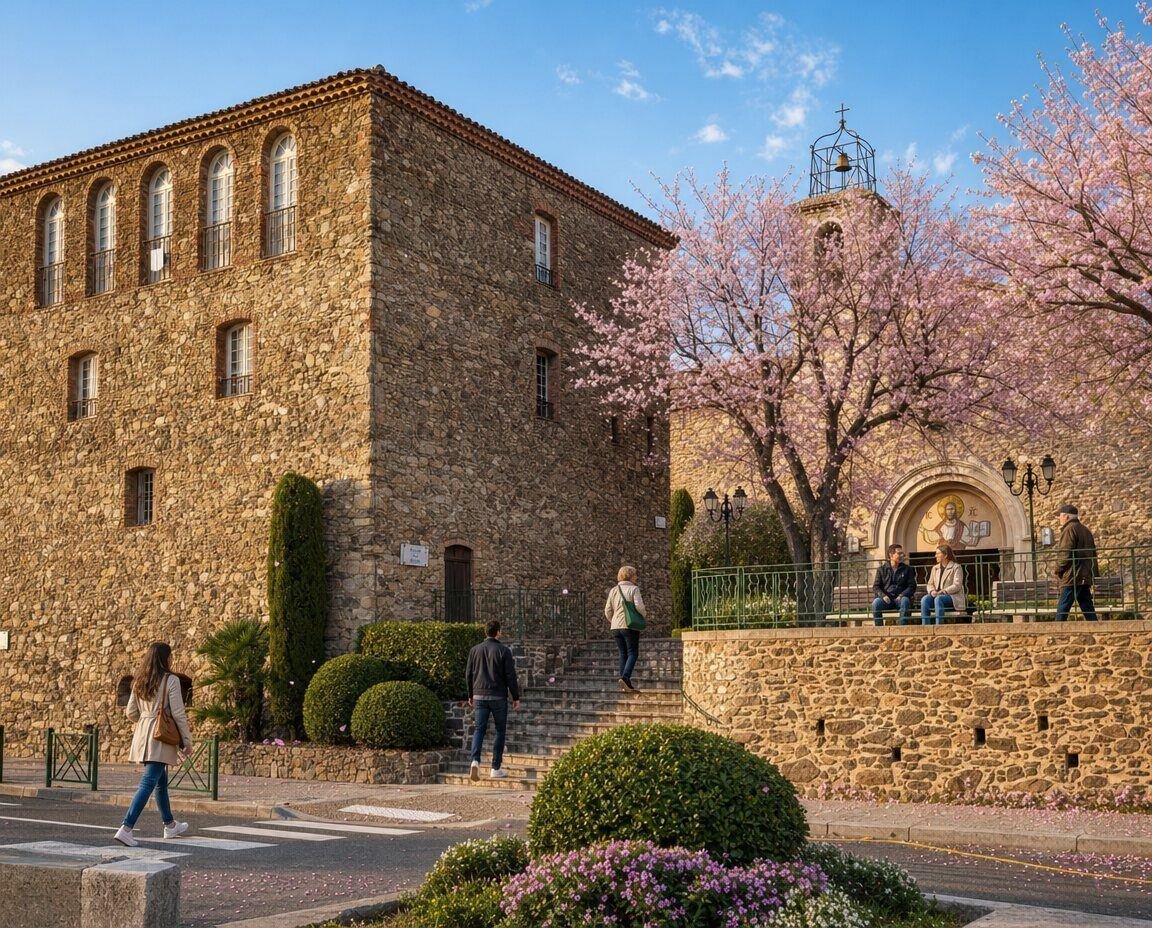
The weather here
11 September 2026
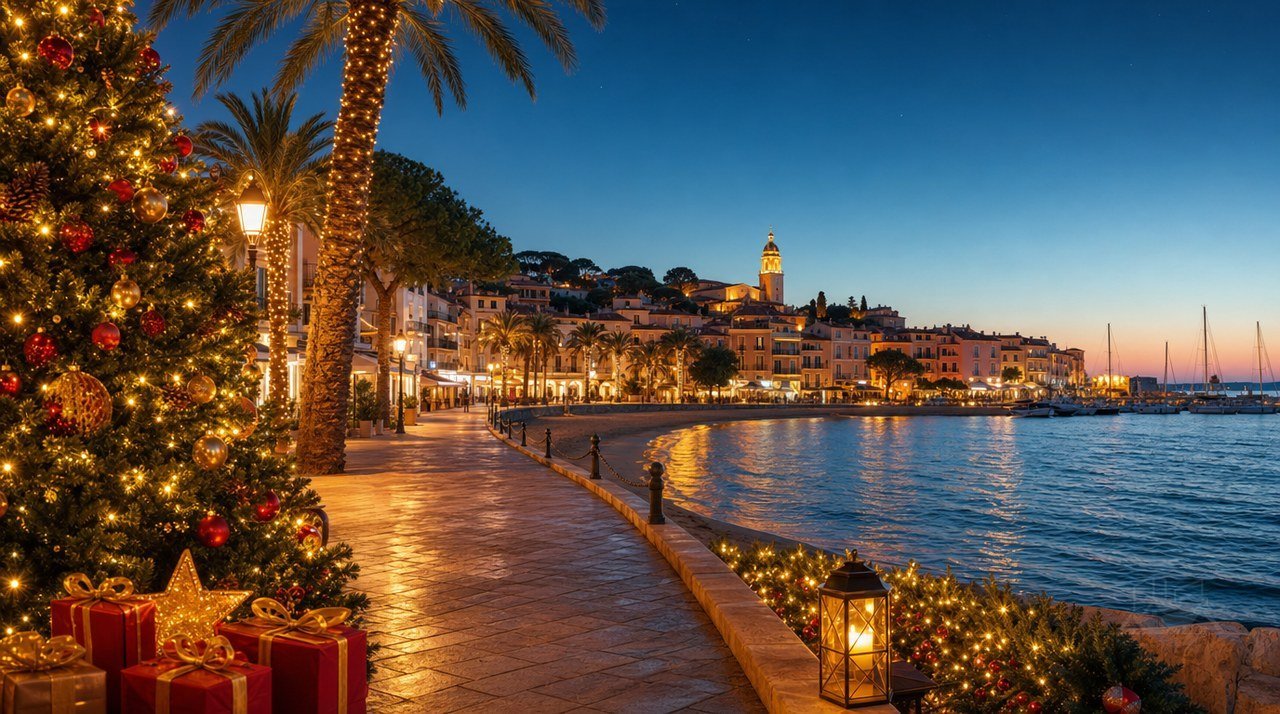
Forty days of fêtes calendales, treize desserts and a lit-up seafront. December is a good season to live here.
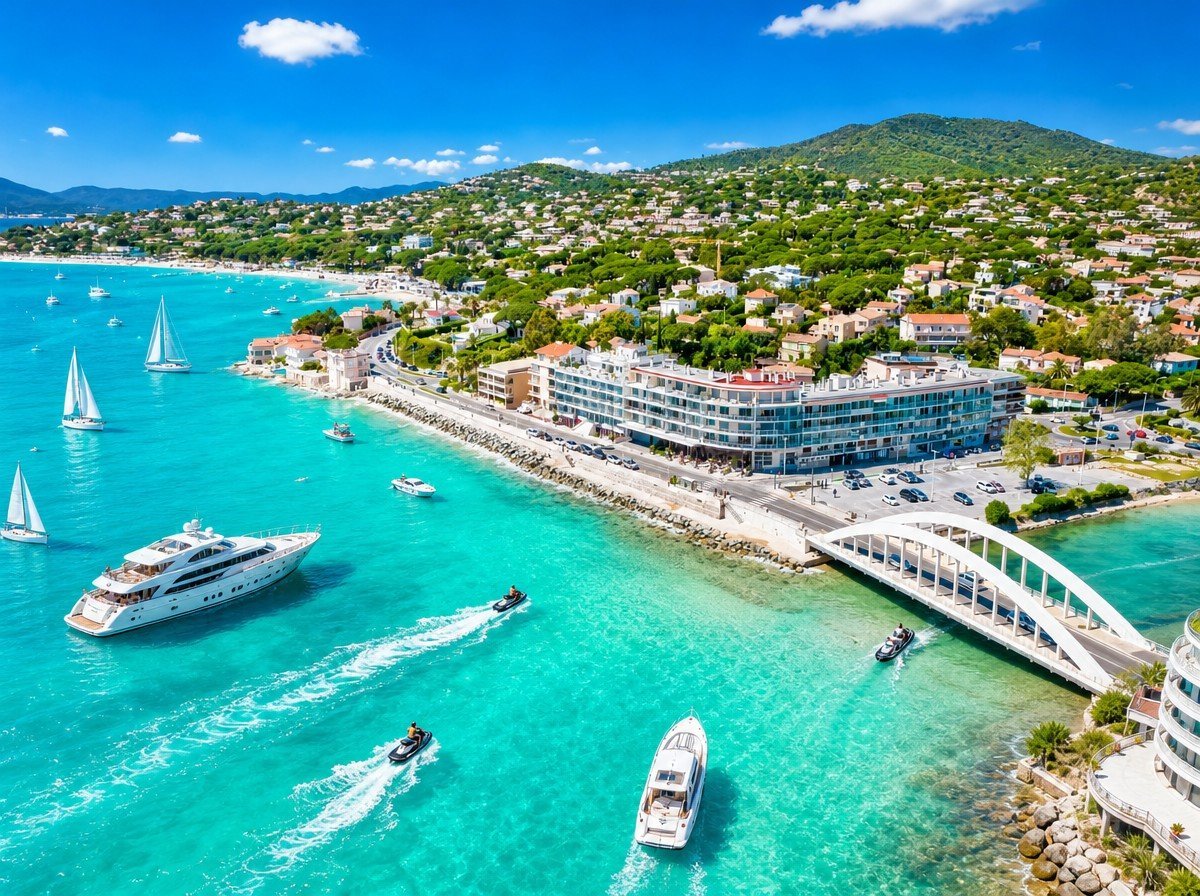
View our homesMany people picture this coast as empty in December. That is a received idea, and our tenants put it right in their first winter. The town comes alive from the end of November, Provence unrolls a calendar of festivities forty days long, and the thermometer stays mild.
Sainte-Maxime sets up its end-of-year festivities on three sites: the promenade Aymeric Simon-Lorière, the boulodrome Prince Bertil and the marquee at the Théâtre de la Mer. It all opens every day, usually from 11am to 8pm, and entry is free.
Year after year you find a food village at the boulodrome, a large funfair on the promenade, a tree some ten metres tall in the town centre and a slide run under the marquee. The switching on of the lights opens the season at the start of December.
Events then punctuate the whole month: a parade, the arrival of Father Christmas, fireworks, a Christmas flea market, a toy sale, and the New Year swim on 31 December. The bibliothèque Jehanne Arnaud, for its part, offers storytelling, music and creative workshops.
One clarification, because the confusion is common. The Sainte-Maxime ice rink does not run in December: it goes up during the winter school holidays, in February, under the marquee at the Théâtre de la Mer. In December, a toboggan run takes over the space.
The exact programme changes every year and comes out only in the autumn. So we do not give dates here. The tourist office, 21 place Louis Blanc, on 04 94 55 75 55, publishes it as soon as it is settled.
In Provence, Christmas is not an evening but a season. The fêtes calendales last forty days, from Sainte-Barbe on 4 December to Candlemas on 2 February. That length explains why the region keeps customs you no longer find elsewhere.
It all starts on 4 December. You sow wheat or lentils in three saucers, which stand for the Trinity. Good germination on Christmas Day promises a good harvest. The shoots then decorate the Christmas Eve table.
2 February closes the period. The santons (the nativity figures) go back in their boxes, and in Marseille the archbishop blesses the navettes, those boat-shaped biscuits. In between, Provence has unfolded its gros souper (the Christmas Eve supper), its vigil and its treize desserts.
Forty days, from Sainte-Barbe to Candlemas: in Provence, Christmas is a season rather than an evening.
The gros souper is the meat-free family meal eaten on 24 December, before midnight mass. It carries no meat, and it counts seven fish and vegetable dishes: aigo boulido (garlic broth), shad, salt cod, cardoon gratin, spinach with snails.
The table is laid with three white cloths, one on top of the other, each smaller than the last. The first serves on 24 December, the second for the Christmas meal with meat, the third for the leftovers on the 25th. Three candles stand for the Trinity, and the Sainte-Barbe wheat completes the setting with a sprig of holly. An extra place is laid for the poor traveller.
The cacho-fio comes before the meal. It is an old ceremony, tied to the solstice, in which a large log of fruit wood goes on the fire: pear, cherry or olive.
The youngest and the oldest of the family carry it together and walk it three times round the table. The youngest pours cooked wine three times, the eldest says the blessing in Provençal. The log must burn for three days and three nights, until Epiphany.
Here is the point almost everyone gets wrong, and it deserves putting right. The first written mention of the number thirteen dates from 1925, from the pen of Doctor Joseph Fallen, a Provençal writer. Frédéric Mistral, in 1854, spoke only of exquisite treats, without ever naming a figure.
The Christmas sweets are therefore old, but counting them to thirteen is a twentieth-century codification. The most widespread reading sees Christ and the twelve apostles. More than fifty-five different combinations have been recorded across villages and families: there is no official list.
Four items come back almost every time, known as the quatre mendiants, the four beggars, in reference to the religious orders that took a vow of poverty.
Walnuts or hazelnuts stand for the Augustinians, dried figs for the Franciscans, almonds for the Carmelites, and raisins for the Dominicans.
To these are added the pompe à l'huile (the olive oil brioche), white nougat and black nougat, fresh fruit such as apple, pear and grapes, and dates. The date is the only exotic fruit on the table, and it recalls the flight into Egypt.
The Provençal santon was born of a constraint. The French Revolution closed the churches and banned midnight mass, so families moved the nativity scene into the home, with small figures called santoun, the little saints.
Jean-Louis Lagnel, a Marseillais born in 1764 and dead in 1822, turned it into a trade. He modelled his characters in raw clay, after his neighbours, in the costumes of the Louis-Philippe period. Sizes run from the santon puce of a few centimetres to the large church santons of twenty-five to eighty centimetres.
The characters have become familiar figures: lou Ravi, the simpleton with his arms raised, Pistachié, the tambourine player, the boumian, and every Provençal trade.
The Marseille santon fair dates back to 1803, on the cours Saint-Louis, and has been held every year since 1897.
Pastorales, finally, are Nativity plays, spoken and sung. The most performed remains the Pastorale Maurel, written by Antoine Maurel in 1844 in Marseille under the title Rei de Glòri, Canten Victòri. It runs to five acts, almost entirely in Provençal, and its role today is as much linguistic as religious.
There is no Météo-France station in Sainte-Maxime. The averages below come from the Fréjus - Saint-Raphaël station, the nearest one, some twenty kilometres away, over the period 1991-2020.
In December the average temperature stands at 9.3 °C, with a daytime average high of 13.7 °C and a low of 4.9 °C. Put another way, a December afternoon here feels like a fine April day in the north of France.
Two figures correct some received ideas. December is not the wettest month: at 96.9 mm it stays below November, which reaches 132.5 mm, and October, at 115.5 mm. It is, however, the least sunny month of the year, with 121 hours of sunshine, which still comes to nearly four hours a day.
In practice, you lunch outdoors on some December days, and you walk the seafront in a jumper. This is one of the reasons our tenants stay several years: winter here remains liveable.
The covered market runs all year, Tuesday to Sunday, and the open-air markets are held on Monday, Thursday and Friday. The ferry to Saint-Tropez runs about nine departures a day in November and December. Everyday appointments, for their part, can be booked within the week.
The parish church of Sainte-Maxime, place Mireille de Germond, comes under the diocese of Fréjus-Toulon. The parish publishes the Christmas service times in December: we do not repeat them here, they change every year.
Finally, December is a good month to view a home. The town shows itself as it lives eleven months out of twelve, parking is simple, and we have time to walk round a flat without watching the clock.
If you are hesitating between two neighbourhoods, come out of season: that is when the difference shows.
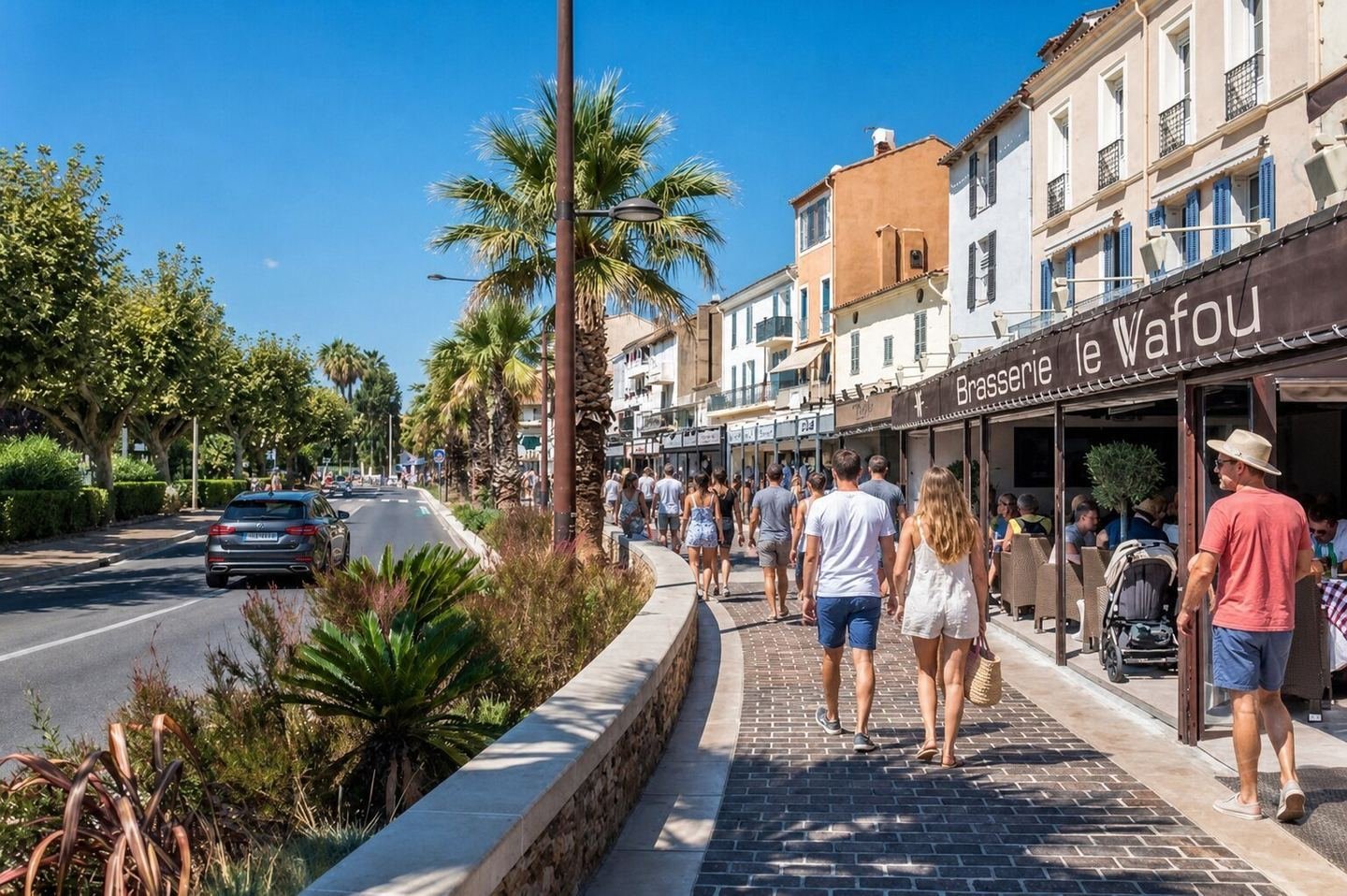
The first winter always surprises a newcomer, and rarely in the way they imagined. They expected a dead town; they find a town that breathes. The shops in the centre stay open, appointments can be booked within the week, and the traffic flows again.
Distances stop being a subject. What takes forty minutes on a Saturday in August takes ten minutes on a Tuesday in December. Parking in the centre, impossible to find in season, becomes a formality again. These are the details that make people stay.
The light counts too. With one hundred and twenty-one hours of sunshine, December remains the least sunny month of the year here, but the brightness of a clear day over the bay has nothing in common with a December inland. Our tenants who come from the north all say so.
A few practical habits make the season easier. Heating first: our homes are fitted with reversible air conditioning or convector heaters depending on the case, and each property's listing states the heating type. With average lows around five degrees, the needs stay moderate.
Then home insurance, compulsory and asked for on the day you sign. Then putting the electricity and water meters in your name, which takes a few days. All three formalities fall in the same week as the move, and they are the three people forget.
Finally, December is a good time to move in. Removal firms are free, tradespeople call back, and the inventory of condition is done without rushing. A winter move leaves you time to settle in before the first season.
You cover the centre of Sainte-Maxime on foot, and the year-end events cluster around the seafront promenade, the boules court and the Théâtre de la Mer. From our developments, the trip takes a few minutes by car, and you walk it from the homes in the centre.
For the Christmas markets in the neighbouring towns, the ferry remains a pleasant way to reach Saint-Tropez, with about nine sailings a day in December. It makes a late-afternoon outing that avoids the coast road and keeps the trip home simple.
So the end of the year here needs no special planning. Everything sits within a few kilometres, the town runs events for five weeks straight, and Provence supplies the rest of the programme.
Setting up a Provençal nativity scene follows a few simple rules. You start it on 4 December, Saint Barbara's day, and you set it against a backdrop of rock-effect paper, with thyme, rosemary and moss gathered in the hills. The wheat sown on the same day completes it.
The figures arrive gradually. The Christ Child is placed on the night of 24 December, and the Three Kings move forward each day from the back of the scene until Epiphany. Everything is put away at Candlemas, on 2 February, at the end of the forty days.
Santons are sold singly, so a nativity scene grows from one year to the next. They are in fact one of the most common gifts in Provençal families, and one reason the Marseille fair has run since 1803.
With an average high of 13.7 °C in December, the seafront promenade stays usable all winter. Runners, walkers and families pass each other there at weekends, and sheltered terraces still serve coffee outside in the middle of the day.
The hills behind the Préconil are also excellent walking at this time of year. The trails are dry between two spells of rain, the heat no longer gets in the way, and the view carries a long way. It is the best time of year to walk in the massif.
Compare that with the summer figures: an average high of 29.3 °C in August, against 13.7 °C in December. That twenty-degree gap completely changes how you use the town. Many of our tenants frankly prefer the cold season.